
AI is uniquely positioned to give businesses a strategic edge by helping identify, extract, and transform tacit knowledge into a true competitive differentiator.
Across any organization, teams run countless initiatives; some succeed, some fail, but every initiative creates stories. These stories explain why a strategic deal was won, why a product experiment took off, or why a promising idea stalled, and they hold the patterns needed to scale success and learn from failure.
Sales teams, for example, accumulate hard-won insight about what differentiates a winning pursuit: the programs that resonated, how the deal was negotiated, which stakeholders mattered, and what objections really changed the outcome. Engineering teams see similar patterns in experiments that drive a step-change in product adoption, revealing not just what worked, but how it was discovered, tested, and shipped.
Every department, team, and individual carries this kind of tacit, experience-based knowledge. The organizations that learn to systematically identify, extract, socialize, and replicate these stories can dramatically accelerate innovation and execution.
This is where AI now plays a transformational role. AI agents can reason across the messy, unstructured exhaust of everyday work; emails, chats, files, and meeting transcripts; to surface the hidden narratives inside an enterprise.
With Microsoft 365 Copilot’s Researcher agent, for example, knowledge workers can ask questions that span their work graph and have AI synthesize the relevant context into clear, reusable insights, turning tacit knowledge into explicit assets the entire organization can learn from and scale
Understanding Tacit v/s Explicit knowledge
Tacit knowledge is the lived, experience-based know‑how people develop over time; insights, intuitions, mental models, and skills that are hard to fully write down or formalize. Explicit knowledge, by contrast, is the codified, structured content that can be easily documented, stored, and shared in artifacts like manuals, wikis, reports, and databases. Both forms are essential, but most organizations vastly under-invest in systematically converting high‑value tacit knowledge into explicit, reusable assets.
Traditional knowledge management systems were designed primarily for explicit knowledge: they index documents, capture process descriptions, and centralize reference material. These systems struggle with the nuance and context that make human expertise powerful things like judgment in ambiguous situations, pattern recognition across edge cases, and the “feel” for how to navigate complex stakeholders. As a result, the richest insights often remain trapped in inboxes, chats, and people’s heads, even when the organization appears to have a mature KM platform.
This gap between what systems capture and what experts know creates a structural barrier to agility, innovation, and scale. When tacit knowledge is not surfaced and shared, teams repeatedly solve the same problems, repeat avoidable mistakes, and depend on a few “indispensable” individuals, slowing down decision-making and execution. Organizations that learn to systematically externalize tacit knowledge, making it discoverable, searchable, and recompilable are far better positioned to adapt quickly, innovate continuously, and scale their best practices across markets and functions
Scenario: Driving sales excellence using the Researcher agent in M365 Copilot
A real-life scenario you could include is how Contoso leveraged generative AI, specifically the Researcher agent in Microsoft 365 Copilot, to boost sales excellence by turning tacit knowledge into actionable insights for its sales teams.
Contoso’s own sales enablement and operations teams use generative AI to distill scattered, experiential insights from sales interactions, emails, meeting transcripts, and CRM systems. Rather than simply summarizing documents, Researcher agent synthesizes this tacit knowledge, producing stories that not only describe what helped win an opportunity, but how it was won. Insights such as executive sponsorships, sales plays, working across organizations boundaries, partnerships, technical depth, roadmaps and deal architectures.
Previously, collecting and piecing together this context would take hours; now, it’s available in moments.
Enter Researcher agent in M365 Copilot
The Researcher agent in Microsoft 365 Copilot is an advanced reasoning assistant designed for complex, multi‑step research tasks rather than quick Q&A. It plans a research workflow, iteratively gathers information from both your work graph (emails, files, meetings, chats) and the web, then synthesizes the results into a structured, source‑cited report you can review, refine, and share.
The recent enhancement to the Researcher agent in Microsoft 365 Copilot allows it to deeply reason over your day‑to‑day work signals, specifically emails, chats, files, and meeting notes/transcripts, rather than just web or static documents. It can now pull together context across Outlook, Teams, OneDrive and SharePoint and synthesize it into a single, structured report that surfaces decisions, risks, follow‑ups, customer context, and open questions that would otherwise stay buried in fragmented conversations.
This new capability is essentially a tacit‑to‑explicit knowledge engine sitting on top of your real work. By reasoning across emails, chats, meeting transcripts, and files, it can surface the “story behind the work” that normally lives only in people’s heads and scattered threads.
In practice, a seller or product lead can ask Researcher to explain how a big deal was won, why a feature direction changed, or what patterns show up across a series of customer conversations, and it will assemble a coherent narrative, with sources, from all those interactions. That narrative turns ad‑hoc judgments, trade‑offs, and negotiations; classic tacit knowledge into explicit assets like playbooks, win‑loss analyses, and decision rationales that can be shared, searched, and reused by the broader organization
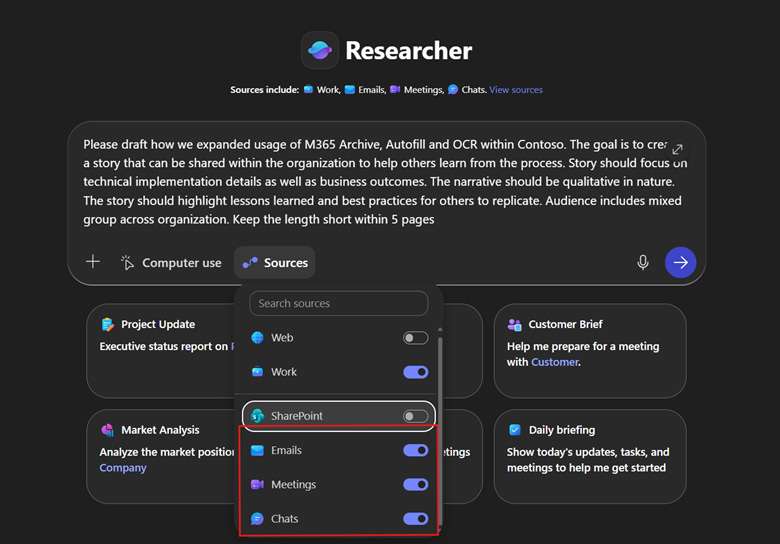
The following is a prompt you can use today in the Researcher agent. Please make sure to select Emails, Meetings and Chats as sources for the agent.
Prompt:
Please draft how we expanded usage of M365 Archive, Autofill and OCR within Contoso. The goal is to create a story that can be shared within the organization to help others learn from the process. Story should focus on technical implementation details as well as business outcomes. The narrative should be qualitative in nature. The story should highlight lessons learned and best practices for others to replicate. Audience includes mixed group across organization. Keep the length short within 5 pages
Amplifying the tribal knowledge into strategic differentiator
The output from the Researcher agent can be packaged and amplified across various channels and programs to reach relevant audiences.
For instance, the insights from the sales deal can be packaged as a win or a loss story for entire sales, marketing and engineering groups. These stories in turn influence the sales playbooks, marketing campaigns and product roadmap.
Leveraging AI to scale human potential
AI creates value not by replacing human thinking, but by amplifying it. Instead of treating AI as a glorified summarizer, leading organizations are using it as a reasoning layer on top of their people’s expertise, capturing the “why” behind decisions, not just the “what” in the documents.